
January 1, 2026, and I’m on the couch comfortably taking in college football, lazily scrolling social media for baseball news during commercial breaks. @CubbiesCrib set the tone for Cubs fans on the X feed:

I, along with every other Cubs fan on X, chimed in with similar posts—especially knowing that Nippon Professional Baseball star right-handed pitcher Tatsuya Imai was under the gun to make a decision.
Resting easy on reports that the Cubs had as good a chance as the New York Yankees, San Francisco Giants, Philadelphia Phillies, or any other Major League Baseball team of landing Imai, I was watching the football and laconically scrolling when I saw the blockbusting news that Imai had signed with the Houston Astros. The Astros? They had not been named as an interested team. I was triggered.
Jon Heyman of the New York Post broke the news: a three-year deal that guarantees Imai $54 million, with an additional $3 million per season if he reaches 100 innings pitched. He also has opt-outs after each season.
@MOCCBomb on X reported that the Cubs were outbid because they would not leave their “comfort zone” to match the Astros’ offer when given the chance.
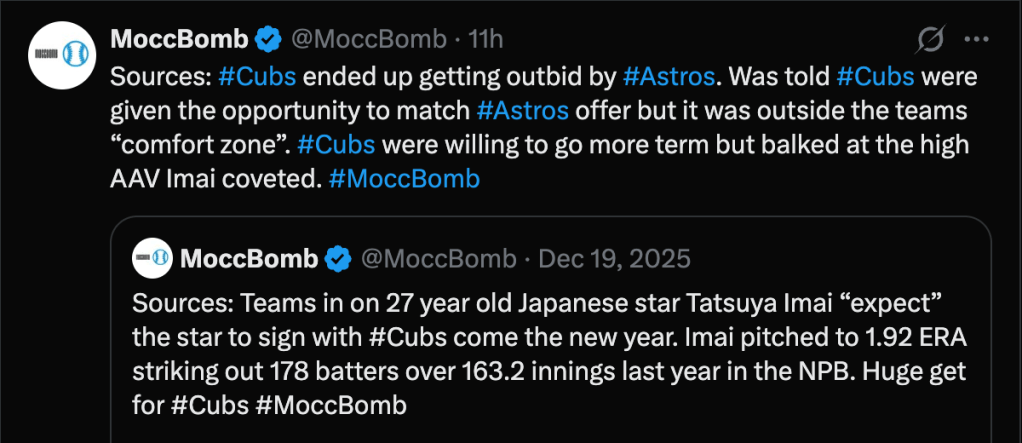
In other words, for about $21 million per year, the Cubs could have landed this affordable, solid middle-of-the-rotation starter—something sorely needed as the Cubs begin the season without Justin Steele.
The Cubs’ “comfort zone” exists in a space where they rank third in revenue, behind only the Los Angeles Dodgers and New York Yankees, yet sit just 14th in payroll—between the Cleveland Guardians and Pittsburgh Pirates, two teams that generate roughly $250 million less in revenue than the Cubs. Fans are frustrated, baffled, and angry.
Over the years, Cubs fans have been given high-dollar impact players such as Cody Bellinger and Kyle Tucker, but they still have not been given a glimpse of ownership’s true aspirations when constructing rosters. Is it World Series or bust? Or is it simply a commitment to fielding a competitive team?
Al Yellon of Bleed Cubbie Blue recently commented that the Cubs’ approach to roster building is “reactionary rather than visionary” (Bleed Cubbie Blue, “An Updated Look at the 2026 Cubs Roster, Payroll, and Luxury Tax,” 12/22/25).
The Cubs appear to view the luxury tax as a hard salary cap, and living beneath it is their comfort zone—where their profit lives. That mindset limits them from fully engaging the market for marquee players who could join the organization, continue to develop, lead the team to championships, and mentor the next crop of Cubs talent.
 Baseball Banter Broadcast
Leave a comment