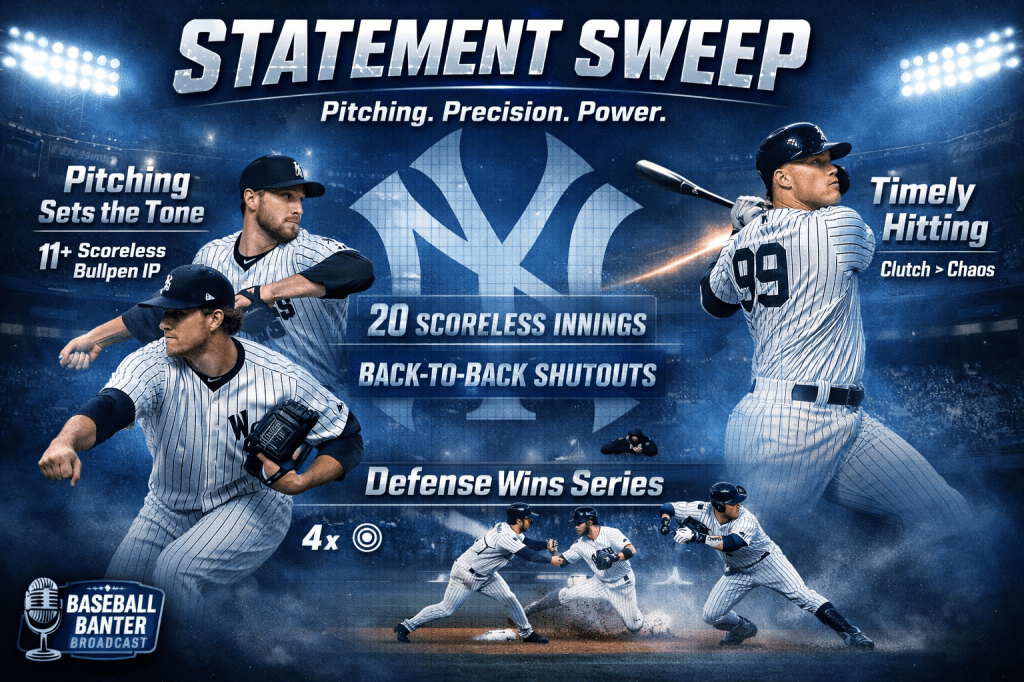
The New York Yankees opened their 2026 season with a performance that was both historic and revealing. In a three-game sweep of the San Francisco Giants, they recorded back-to-back shutouts and began the year with 20 consecutive scoreless innings.
For a team long defined by offensive production, the nature of these wins stood out. The Yankees did not rely on explosive scoring or late-game rallies. Instead, they controlled the series through consistent, disciplined pitching that limited opportunities and dictated the pace of play from the outset.
Pitching Sets The Tone
The pitching staff was the defining force in the series. After a historic start that featured back‑to‑back shutouts and 20 consecutive scoreless innings to open the season, the Yankees’ rotation and bullpen continued to set the tone throughout the three games.
Max Fried and Cam Schlittler threw terrific starts in the first two games, combining for 11 ²/₃ scoreless innings with the relievers accounting for 6 ¹/₃ more. In the finale, starter Will Warren allowed just one run over 4 1⁄3 innings. The bullpen, featuring Brent Headrick, Jake Bird, Tim Hill, and closer David Bednar, combined for 4 2⁄3 scoreless innings to secure the win. Overall, the bullpen has now started the season with 11 straight scoreless innings.
The starters and relievers kept the Giants from creating scoring chances or gaining momentum, giving the Yankees control of every game. This is a contrast to the usual high-scoring early-season matchups.
Timely Support from the Offense
Although pitching was the centerpiece, the Yankees received critical offensive contributions from almost the whole lineup when they were needed.
Aaron Judge homered in consecutive games, including in the series finale, underscoring his value as both a run producer and a stabilizing presence in the lineup. Ben Rice provided a key two‑run double in the third inning of the final game that put New York ahead for good.
These timely hits helped the Yankees turn strong pitching performances into clear victories.
Defensive Impact and Smart Play
Defense also played a role in New York’s dominance. The Yankees turned four double plays in the series finale alone, including three in the final four innings, showcasing their ability to limit damage and escape pressure.
Austin Wells, who caught all 27 innings of the series and managed a pitching staff that allowed just one run, made a notable impact with two automated strike‑zone challenges.
Putting It in Context
While this sweep and early run prevention are impressive, it remains early in the season. Small sample sizes in baseball can often be misleading, as teams often perform differently over the long haul of a 162-game schedule.
Nevertheless, the way the Yankees won deserves attention. They didn’t just protect small leads; they limited the Giants’ chances, hit well in key moments, and supported it all with strong defense and dependable relief pitching.
Early Implications
If this level of pitching consistency and situational hitting continues, the Yankees could position themselves as contenders not just in the American League but across the league. Teams that can prevent runs reliably while still producing timely offense are difficult to beat over a long season.
For now, the sweep offers an early indicator of strength and balance. It suggests that the Yankees may not need to rely solely on their lineup’s power to succeed. By complementing timely hitting with deep, effective pitching and sound defense, they’ve shown a blueprint that could serve them well long after opening week.
 Baseball Banter Broadcast
Leave a comment