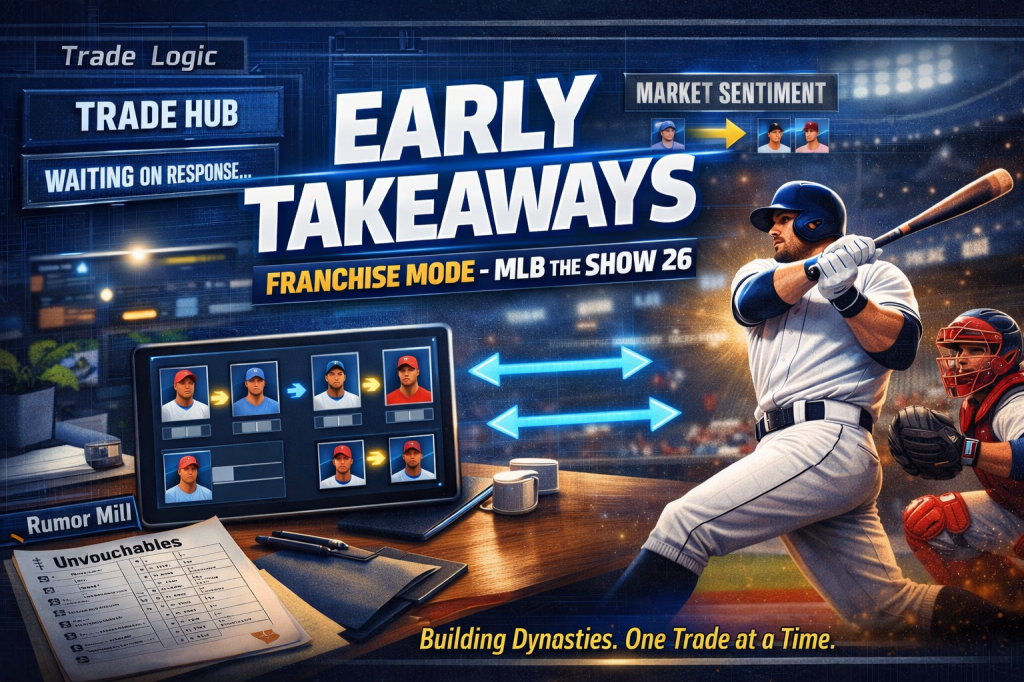
Earlier this year, I wrote about some early returns and takeaways about the “Road to the Show” mode on MLB The Show 26. And while I’m still playing through that mode in an effort to make it to the Hall of Fame. The mode that I spend significantly more time in is that of franchise mode. I will usually have a few different play throughs of this mode. And in this article, I want to breakdown some of my early thoughts on franchise mode.
One of the main reasons that I absolutely love playing franchise mode is for the “general manager-esque” power that the mode offers. Being able to control a team and try and build them into a winner, is a rewarding experience. Taking my favorite team the New York Yankees and making them the perennial powerhouse that they used to be is always my goal. And the way that I try to complete the greatest team ever assembled is by making a plethora of trades. The amount of trades that I make in my franchise simulations are ridiculous. I tend to joke and call the Seattle Mariners’ gm, Jerry DiPoto the “Vitamin GM” because he seemed to make trades once a day like taking vitamins. However, on MLB The Show’s franchise mode, I am even more active than that. This year’s iteration has made several changes to the trade system, and my honest reaction is I’m not sure how to feel about them, yet.
TAKEAWAY #1: Changes to Trades
The first change was the removal of instant trade feedback. Like in real life, general managers rarely get deals done the moment they first speak. Thus, the move back to having to wait a day or seven to hear back from another team about your trade proposal adds an interesting wrinkle to the proceedings. It makes the situation of making trades that much more involved and strenous to try and make a strong trade offer. While San Diego Studios has claimed that the “new trade logic” is much improved and that crazy ridiculous and unlikely trades are far less likely to happen. It still happens! With the budget feature turned on I was able to trade for and acquire Austin Riley (and Tyler Kinley) of the Atlanta Braves for Anthony Volpe, Ryan McMahon, Seth Brown, and prospect Adam Kloffenstein. A trade while “somewhat” possible, it is highly unlikely that deal would ever get made between Brian Cashman and Alex Anthopoulos. Another trade was downright NOT EVER HAPPENING in real life was a one-for-one trade of Jazz Chisholm Jr for Jose Ramirez. The level of absurdity that it would take for Cleveland to trade away their franchise star for an impending free agent in Jazz is a wild thought that can only be made by someone on an acid trip. (Shoutout to Doc Ellis, iykyk.) I was also able to acquire Jeremy Pena, Bryce Harper, Sal Frelick, Joey Ortiz, Blake Perkins, Cade Smith, and Erik Sabrowski for a combination of Clarke Schmidt, Giancarlo Stanton, Trent Grisham, Cody Bellinger, Paul Goldschmidt, and a host of other veterans and prospects. None of which I believe could happen outside of MLB The Show.
So beyond the logic struggles that still persist, (honestly to my benefit), the removal of the trade suggestor seems like an unneccesaary thing to take away. It may be a subtle feature that causal franchise players may not even think about, but as someone who’s always on the hunt to trade, the trade suggestions made for an incredible foundation for some highly aggressive trade scenarios for me in the past. I guess, if you’re trying to “improve the realism” there isn’t a trade suggestor that MLB gm’s can use to get some suggestions on improving their teams. (Well that’s not entirely true as BaseballTradeValues.com does have a pretty nice trade simulator.) But the comments the opposing GM’s give you are key insights to what they are looking for in a potential trade opportunity. You just have to understand how to read between the lines.
TAKEAWAY #2: TRADE HUB IS GOOD
Now, the changes to trades are not all bad, the new sectional addition of the trade hub, groups a lot of formerly separated trade features together into one clean section. By having these different sections grouped together is makes for a much more streamlined experience. I like the “fog of war” features with the rumor mill and the fact that some of the things being mentioned there are not actually true. It’s like reading Jon Heyman’s tweets. In a game mode as in-depth as franchise mode can be, having the streamlined section of the trade is a solid and clean addition.
The added features beyond the trade block that’s been in the game for some time now, but also the adding in of a larger more expanded untouchables section has added to the depth of the realism the mode intends to deliver on for it’s users. Seeing the “market sentiment” of what could he easier or more difficult to acquire makes it feel like there are beat reporters writing out stories on the things happening around the league. Also the ability to have twenty players on both the trade block and the untouchables list feels like the right amount of players to have blocked and available. As I stated previously, I am one that loves to make a lot of trades and even I had a hard time filling out both the trade block and untouchables list both before and after my plethora of trades.
TAKEAWAY #3: GENERAL MANAGER & MANAGER SECTIONS
Another addition to the streamling process is the separation of the different sections of responsibility. There are certain players that only care about the GM responsilities, while other care only for the on-field manager duties. Having the responsibilities separated makes it a much easier process. Beyond the job duties, one of the other changes that SDS has made is about the intelligence of the automated system. Specifically when it comes to how to set lineups and pitching rotations. This improved logic has been something that was heavily featured during SDS’s feature premieres about franchise mode. Having the sections separated by gm and manager just make for a more streamlined process. Which is something that seemed to be an area of focus for the developers.
TAKEAWAY #4: REAL LIFE KIND OF FUNCTIONALITY
There’s something surprising, downright shocking even when division rivals make trades. And with the new trade logic system that becomes even more difficult. There will not be easy negotiations between rivals. Another aspect of difficulty will be depending your team of choice, as market size will be the factor into the automated decision system. Referencing back to one of my trades from earlier when JRam was traded by the Cleveland Guardians for Jazz Chisholm Jr, the size of Ramirez’s contract could have played a factor into why the Guardians were willing to make that move. Chisholm is an impending free agent and won’t cost the franchise quite as much money, because they will likely let him walk when the season is over. While at the same time, my New York Yankees will be on the hook for the rest of Jose’s contract. Although, Ramirez should age gracefully with his particular skillset, it’s still a larger contract than the Guardians will likely want to deal with, thus the trade.
Now, I haven’t gotten to the point in the season where trades really take place to know if the trade logic that is supposed to take hold when buyers and sellers actually make deals. But as of right now, based on the feedback from the trades that I have offered that have been rejected, it should make for an interesting time as the trade deadline approaches.
TAKEAWAY #5: EXTRA TRADE SLOT
It may seem like a small thing to add in the fourth trade slot per side, but it adds tremendous depth to the trading system. I can not begin to tell you about the countless times when having that fourth slot in prior years past would have garnered me even more success on the trade front for superstar players. Having the extra trade slot gives the extra boost that can make a potentially rejected trade get pushed over the top. As has been clear throughout this article, I love to make trades so the wheeling and dealing aspect with the extra trade slot gives me all the more ammunition to shoot my shot on otherwise even more highly unlikely trades.
FRANCHISE REVIEW
I haven’t gotten through all the ins and outs of franchise mode yet, but I will. The difference for me is I enjoy every aspect of the mode. It’s not just about making trades or negotiating free agent contracts. It’s also about playing the games and trying to set and break records there too. A few years ago on the Baseball Banter Broadcast YouTube channel, I ran a series where I played (simulated the games) franchise as the GM of different franchises and tried to turn them into a World Series winner. It was a series that was a but involved but I enjoyed it. Maybe with all the newer features in franchise mode, it lends itself to once again bringing the series back.
 Baseball Banter Broadcast
Leave a comment