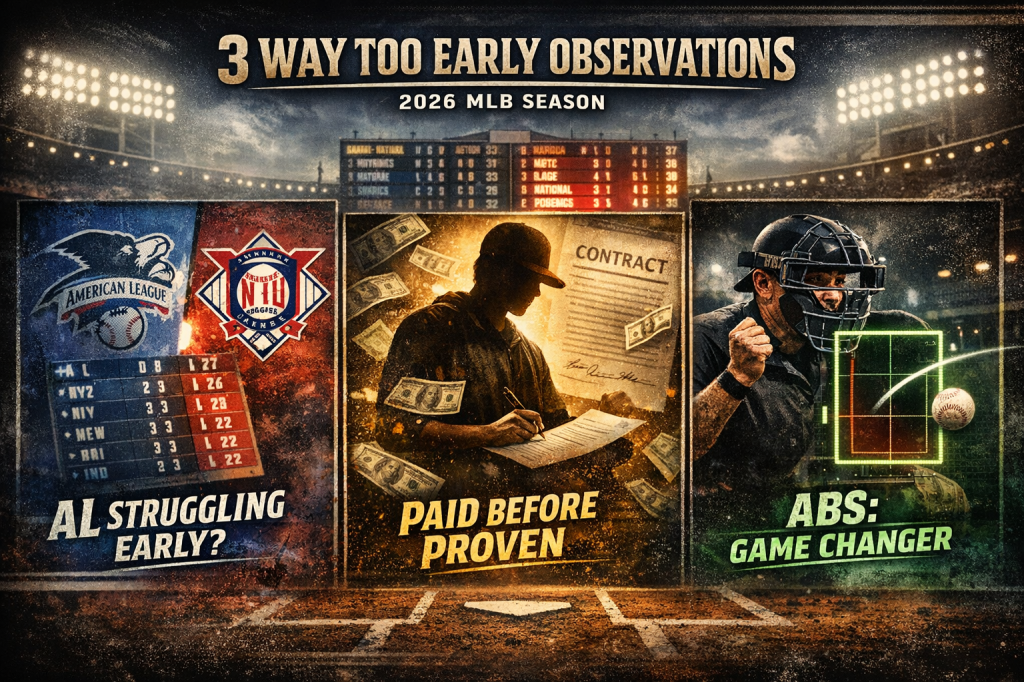
While the 2026 season may be underway, it is far too early to start making any judgments about the season. Yet, for this article that is exactly what we are about to attempt to observe. So let’s not waste any more time and dive into three far too early observations for the 2026 MLB season.
EARLY OBSERVATION #1: THE AMERICAN LEAGUE IS THE WEAKER LEAGUE
Taking a look at the way-too-early standings, there is a glaring fact about the AL and the NL. The American League looks like its nickname would suggest, the junior circuit. At the time of this writing, the American League has only five out of fifteen teams that are at .500 or better. While the National League on the other hand has eleven out of fifteen teams at a .500 record or better. Now yes, again, as previously stated it’s far too early to begin scoreboard watching or obsessing over standings, but it’s an interesting early observation to see playing out in real time. Many of the 2025 AL postseason teams have gotten off to poor starts. And while you would expect them to rebound relatively quickly given the pedigree of players on the team, it’s still something to bear witness to early in this 2026 season.
EARLY OBSERVATION #2: BIG MONEY FOR NO SERVICE TIME
There’s been a recent trend for teams to try to lock up their young players in an effort to keep the cost down on potential future superstar players. This season in particular has seen quite a few big-money deals handed out to players who have no Major League service time. Colt Emerson and Cooper Pratt are the players who most recently fit that certain parameter, in terms of no service time. But even bigger news is Konnor Griffin of the Pittsburgh Pirates, who had seemingly like twenty minutes of service time before receiving his nine-year $140 million extension contract with the Buccos. These early contract offers come with risk/reward for all parties involved. Obviously, for the ballclubs they are hedging their bets if the player turns out to be a superstar. But it also comes with the inherent risk that the player turns out to be a bust or worse yet has some sort of trouble away from the field. (Sorry Tampa, we won’t mention any names.) And for the player, the risk becomes in outplaying the contract and potentially leaving money on the table for a larger contract down the road via free agency. There’s a lot that’s going to be made about money and the financials of the game of baseball this coming offseason with the Collective Bargaining Agreement set to expire. But for now, we’ll just marvel at the number of young players in our game getting paid before they’ve even played in a regular-season Major League game.
EARLY OBSERVATION #3: ABS CHALLENGE SYSTEM A ROUSING SUCCESS
Besides bruising the egos of a few umpires aside, the Automated Ball Strike system or ABS has been a wonderful and dare I say it successful addition to the game. Obviously with every overturned call is seems to simply confirm two key facts about umpires. First, the umpires are human and capable of error and should be afforded the courtesy not to be overly judged by their misses. Because as was once said by Alexander Pope, “to err is human”. However, more importantly, the second fact is that most umpires are extremely good at their jobs. And while the good ones get lumped in with the bad ones, (yes, we’re looking at you CB Bucknor) they’re not all horrendous as we’ve believed for many years. When an umpire has a call overturned by less than an inch that is nearly imperceptible to the human eye. Those are not even calls The that unpires for be faulted for missing. The ABS challenge system is about getting the egregious calls fixed. And thus far this system has been able to help build in a new layer to today’s game and a positive addition when asking nearly every baseball fan.
 Baseball Banter Broadcast
Leave a comment