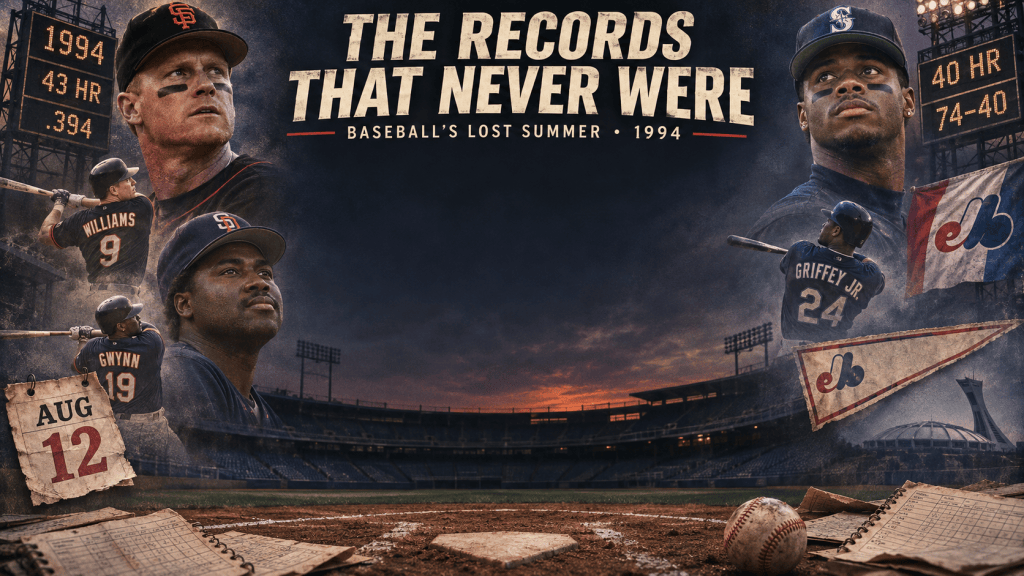
The 1994 Major League Baseball season gave fans everything they hoped to see. Matt Williams was chasing Roger Maris’ all-time home run record, Tony Gwynn was close to hitting .400, and Ken Griffey Jr. put together a strong power-hitting season in Seattle. It seemed as though every game that year brought something to talk about.
Then, on August 12, everything stopped.
The baseball season was cut short due to a dispute over contract negotiations between owners and players. The following month, MLB called off all remaining games, except the World Series. This is only the second time (the first was 1904) that there has been no baseball champion.
The players’ strike severely harmed the connection between the game and its supporters. However, the strike produced several interesting queries. A significant number of players were experiencing career bests. Additionally, a small group of players had the opportunity to have their names listed among baseball’s greatest of all time.
Over 30 years later, I find myself thinking about what could have been accomplished during the last seven weeks.
Matt Williams Had Roger Maris in His Sights
Williams, a third baseman for the San Francisco Giants, was experiencing what most power hitters can only hope for: a successful year.
After playing 112 games, Williams had hit 43 home runs. He was on pace to hit 62 over a full 162-game season. This would have been one more than what Roger Maris hit with the New York Yankees in 1961.
After 33 years as the only person who could top Maris, Williams was finally giving fans hope that things might be different.
He wasn’t the biggest star in the majors; however, he had some of the most powerful swings. He was already established as one of the best power hitters in the National League, and pitchers were finding fewer spots to pitch to him without getting injured.
The Giants were scheduled to play 47 additional games. Williams would need to hit 19 more home runs to break the existing home run record, a daunting feat; however, it was not completely out of reach given his recent success.
Instead, his season ended after 43 games. He finished second in the National League MVP race, but baseball fans will never know whether he would have continued his torrid pace.
After four years, Mark McGwire surpassed Maris’ single-season home run record by hitting 70 home runs. Williams was unable to find another opportunity to achieve what he achieved in 1994.
Tony Gwynn Was Six Points Away From.400
While Ted Williams pursued home run glory in San Francisco, Tony Gwynn was reaching similar heights on the opposite side of the state in San Diego.
Gwynn hit.394 when the baseball strike began. No qualifying Major League hitter has finished a season at .400 or better since Williams hit .406 for the Boston Red Sox in 1941.
The Padres legend wasn’t getting there by accident, either.
Gwynn has 165 hits in 110 games and has only struck out 19 times. When Gwynn sees the ball clearly, there’s nothing a pitcher can do. He can hit an inside pitch, send a ball through the left side of the infield, or hit a ball into the gap.
He still faced a tough task. If he had one poor week, his average might have dropped a few percentage points; maintaining .400 until the end of the season would require him to be very consistent.
But if anyone in baseball had the method to achieve this goal, Gwynn would be an excellent choice.
He retired with eight batting titles and a .338 lifetime batting average, but his incomplete quest for .400 will always be remembered as one of the greatest “what-if” moments of his Hall of Fame career.
Ken Griffey Jr. Wasn’t Far Behind Williams
Williams wasn’t alone in chasing Maris.
Griffey had hit 40 home runs for the Seattle Mariners, putting him on track to hit about 58 that season.
Griffey, the most popular player in baseball at the time, had several things going for him: his backward baseball cap, an easy-looking swing, and amazing defensive abilities. He was a hit with many younger fans. People would stop everything else to see him take a turn at bat.
What if Williams and Griffey were still alive today, and each was going after 61 in September?
Two of the best hitters in baseball had varying styles; however, each could carry a team on offense for long periods. After hitting 56 home runs in both 1997 and 1998, Ken Griffey Jr. showed that his 1994 home run total was no one-time occurrence.
There is no way of knowing whether he could catch Williams or Maris. Baseball denied him this opportunity.
Chuck Knoblauch Was Chasing a Record From 1931
Home runs got most people’s attention; however, Minnesota Twins second baseman Chuck Knoblauch had quietly had a great year that deserved much more credit than he received.
Knoblauch had 45 doubles when the game was suspended, so he would have been able to challenge Earl Webb’s single-season record of 67, set by Webb while playing for the Boston Red Sox in 1931.
His pace projected to approximately 65 doubles over 162 games.
Knoblauch was not the only player with many double base hits. Both Craig Biggio of the Houston Astros and Larry Walker of the Montreal Expos each hit 44 doubles.
If three different players could hit 60 doubles in a single year, it would be an incredible feat. For over 60 years, Webb’s double record has remained untouched. However, multiple players are now attempting to break that record.
Knoblauch had to perform at his best to surpass the record; however, he had already shown he could do so.
Jeff Bagwell Was Having an Incredible Season
Jeff Bagwell’s 1994 numbers still jump off the page.
The Houston Astros’ first baseman hit .368, with 39 home runs and 116 RBIs while maintaining a .750 slugging percentage through 110 games.
The total number of points that many players will score throughout a year.
Before he broke his hand right before the strike, Bagwell was on track to hit about 57 home runs and drive in around 171 runs, but the injury made it uncertain how much of the rest of the year he would be able to play.
While it was highly improbable that he would surpass Hack Wilson’s record of 191 RBI in a single year, reaching either 160 or 170 RBI would have put him among an elite group of players.
The abbreviated schedule did not prevent Bagwell from being unanimously named National League MVP. One can only imagine what his numbers could have been had he remained healthy and the season continued.
Frank Thomas and Albert Belle Were Putting Up Huge Numbers
The American League had its own collection of hitters doing serious damage.
First baseman Frank Thomas of the Chicago White Sox hit .353, hit 38 home runs, drove in 101 runs, and scored 106 runs. Thomas’ OPS (On-Base Plus Slugging Percentage) was 1.217, which was the highest in the major leagues. He appeared to be headed toward winning his second consecutive MVP Award.
Thomas wasn’t just hitting home runs. He was also taking walks, getting on base, and making the opposing pitcher work each time he stepped into the batter’s box.
In Cleveland, Albert Belle was putting together another monster season.
Belle was on pace to finish the season with 50 home runs and 150 RBI’s after hitting 36 home runs and driving in 101 runs. Belle’s strong performance has been a key factor in the Cleveland Indians’ development into a legitimate championship candidate.
Barry Bonds was also having an excellent year with the San Francisco Giants, hitting 37 homers before the lockout.
Had the season been played out, more than one player may have hit 50 home runs in a single season. The mere fact that this could have occurred would have made 1994 a year to remember.
Kenny Lofton Was Making Life Miserable for Pitchers
Not every player needed to hit the ball over the fence to dominate a game.
When the season concluded, Cleveland center fielder Kenny Lofton was batting.349, had stolen 60 bases, and scored 105 runs.
Lofton was projected to steal about 87 bases, which would have been an exceptional number regardless of whether he came anywhere near Henderson’s all-time mark of 130.
Pitchers had to think about Lofton before he reached first base. After Lofton reached first base, he could turn a walk or hit (single) into a run within a couple of pitches.
His spot in the Cleveland Indians’ starting lineup made him a very exciting player to watch on the field.
Lofton stole over 600 bases in his career; however, 1994 may have been his best year overall.
Pitching Records Were Also in Jeopardy
While hitters grabbed most of the headlines during the 1994 season, several pitchers were putting together impressive years of their own.
Atlanta Braves ace Greg Maddux was nearly unhittable, finishing 16-6 with a remarkable 1.56 ERA in 202 innings. His ERA was the lowest in the majors since Dwight Gooden posted a 1.53 mark in 1985, an incredible accomplishment during a season dominated by offense.
New York Mets right-hander Bret Saberhagen was making history with his control, recording 143 strikeouts on just 13 walks for an 11.00 strikeout-to-walk ratio and breaking a longstanding major league record.
Meanwhile, Yankees left-hander Jimmy Key had 17 wins, Montreal’s Ken Hill had 16, and Seattle’s Randy Johnson had already struck out 204 batters, putting him within reach of 300. None of those pitchers got the opportunity to finish what they started.
Although baseball’s biggest pitching records weren’t necessarily going to fall, the strike took away the chance to see just how special those seasons could have become.
The Montreal Expos Lost Their Best Chance at a Championship
Individual records weren’t the only things lost that summer.
At the time of the strike, the Montreal Expos had the best record in Major League Baseball, with 74 wins and 40 losses. At that rate, the Expos were projected to finish the season with approximately 105 total wins. Additionally, the Expos had a roster full of players who could potentially defeat any team they faced.
In 1994, Moisés Alou, Larry Walker, Marquis Grissom, and Pedro Martínez established the Montreal Expos as a viable World Series contender.
This was the chance for a franchise to make it to the Fall Classic, something it had never done.
The Yankees had an outstanding year with a record of 70 wins and 43 losses. After years of playing in search of a chance to play in the postseason, Don Mattingly seemed to be on track to get that opportunity in October.
Neither club got the chance to find out how far it could go.
Montreal’s lost opportunity grew increasingly painful with time. The Expos never reached the World Series before their relocation to Washington after the 2004 season.


Leave a Reply