For many baseball fans, the Hall of Fame debate often centers on players with eye-popping statistics and major individual awards. Yet some players built their legacies in different ways, combining consistent excellence, postseason success, and winning contributions that helped define an era. Few players fit that description better than Bernie Williams.
Big Part of the Dynasty
Williams was a cornerstone of the Yankees teams that dominated baseball in the late 1990s and early 2000s. As a switch-hitting center fielder, he provided a rare combination of power, contact ability, and defensive reliability.
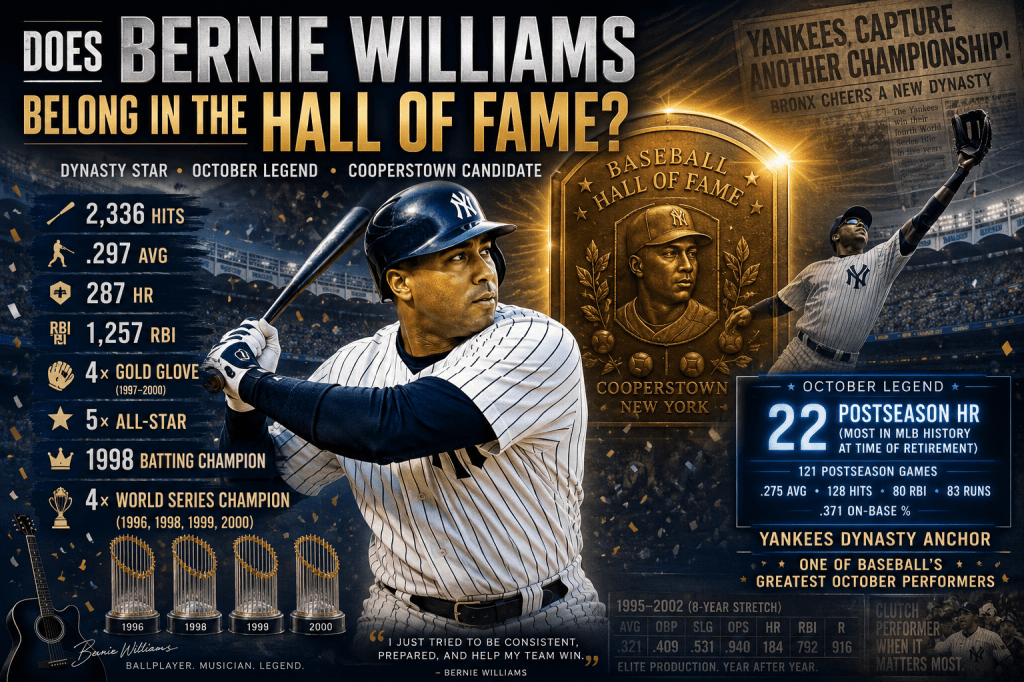
From 1995 through 2002, Williams hit .321 with a .409 on-base percentage, a .531 slugging percentage, 184 home runs, 792 RBIs, and 916 runs scored. During that eight-year stretch, he averaged 23 home runs, 99 RBIs, and 115 runs per season while posting an OPS above .900 six times.
His impact extended far beyond the box score. While stars like Derek Jeter, Mariano Rivera, and Andy Pettitte often received much of the attention, Williams was every bit as important to the Yankees’ success. He helped lead the franchise to four World Series championships and six American League pennants during his career.
The Numbers Compare Favorably
Williams finished his 16-year career with 2,336 hits, 449 doubles, 55 triples, 287 home runs, 1,257 RBIs, 1,366 runs scored, and a .297 batting average. He also posted a .381 on-base percentage and .477 slugging percentage, good for an .858 OPS.
He was selected to five All-Star Games, won four Gold Gloves, captured the 1998 American League batting title with a .339 average, and received MVP votes in seven different seasons.
Advanced statistics strengthen his case. Williams accumulated 49.6 WAR according to Baseball Reference and 43.3 JAWS, placing him in the conversation with several Hall of Fame outfielders. He also finished his career with 2,076 games played and reached the 100-RBI mark five times.
What makes his résumé stand out is his consistency. Between 1995 and 2002, Williams never hit lower than .307 in a full season and reached base at an elite level year after year.
One of the Greatest Postseason Performers Ever
Perhaps the strongest argument for Williams’ Hall of Fame candidacy comes from his postseason résumé. In 121 playoff games, Williams hit .275 with 128 hits, 22 home runs, 80 RBIs, 83 runs scored, and a .371 on-base percentage. His 22 postseason home runs were the most in Major League Baseball history at the time of his retirement.
Williams ranks among the all-time postseason leaders in games played, hits, runs scored, doubles, and RBIs. He consistently delivered against elite competition on baseball’s biggest stage. One of his most memorable moments came during Game 1 of the 1996 American League Championship Series when he blasted a walk-off home run against the Orioles. It was a signature moment in what became the beginning of the Yankees’ dynasty.
The postseason is where baseball legends are often made, and Williams repeatedly answered the call.
Defense Matters Too
While most discussions focus on his offensive production, Williams was also a valuable center fielder. He won four consecutive Gold Gloves from 1997 through 2000 and handled one of the most demanding positions on the field throughout his career. During his prime, he combined range, instincts, and a strong enough arm to remain an asset in the center.
Playing center field while producing middle-of-the-order offensive numbers significantly boosts his Hall of Fame argument. Few players can match that combination of offensive and defensive value over such a long period.
Why He Remains on the Outside Looking In
The biggest obstacle to Williams’ candidacy is the lack of traditional Hall of Fame milestones. He never reached 3,000 hits, never hit 500 home runs, and never won an MVP Award. He also played during an era loaded with superstar outfielders, including Ken Griffey Jr., Barry Bonds, Manny Ramirez, and Jim Edmonds. As a result, Williams was often overshadowed despite being one of the game’s most complete players. When Hall of Fame voters compare candidates from that era, Williams can sometimes get lost among players with more eye-catching individual accomplishments.
The Verdict
Williams may not have been the most dominant player of his generation, but he was one of the most complete and consistent. He accumulated more than 2,300 hits, nearly 300 home runs, four Gold Gloves, a batting title, five All-Star appearances, and one of the greatest postseason résumés in baseball history.
His combination of offensive production, defensive value, durability, and championship success helped one of the greatest dynasties the sport has ever seen. Whether he eventually earns a plaque in Cooperstown remains uncertain. However, when the totality of his career is examined—not just the milestone numbers- Williams has a case for being remembered as a Hall of Famer.


Leave a Reply